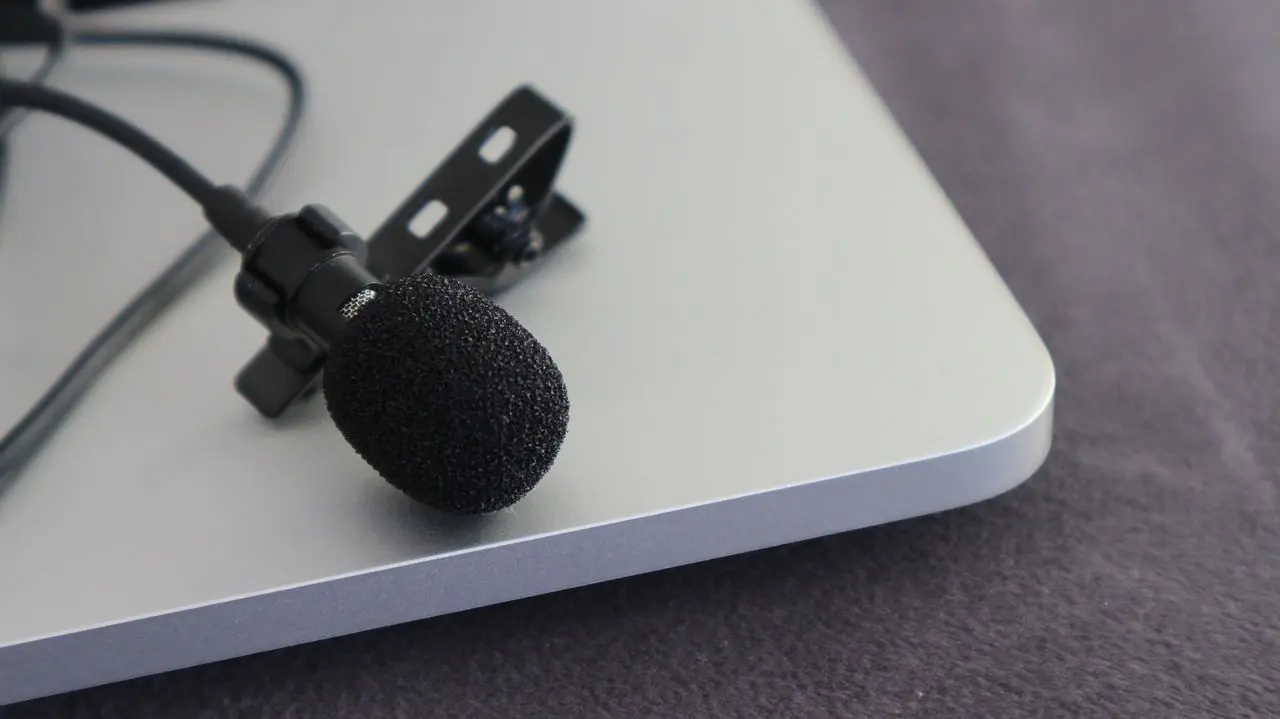
A wireless lavalier microphone is a small clip-on mic whose signal travels by radio to a receiver plugged into a phone, camera or computer, leaving the speaker’s hands free and no cable trailing across the frame.
Lavalier systems sit alongside the choices covered in the gadget buying guide, and this page explains how they work and what the specifications mean.
What a lavalier microphone is
Wikipedia describes a lavalier as a small microphone used for television, interview and other studio applications to allow hands-free operation, usually attached to a collar, tie or other clothing with a small clip (Wikipedia). The same entry notes that lapel microphones date from 1932, so the basic idea is far older than phones and vlogging.
The word “lavalier” originally referred to a pendant worn on a necklace, and the name was applied to microphones hung around the neck, a usage Wikipedia traces to the 1930s. Today the term covers the tiny capsule that clips to clothing, whether it is wired to a pocket transmitter or built into the transmitter itself.
The capsule can be a separate lead plugged into a body-pack transmitter, or a compact transmitter clipped straight to a shirt with a microphone built in. Rode’s Wireless ME, for example, includes a microphone built into both the transmitter and the receiver, according to the maker’s product page (Rode). Both layouts are called wireless lavalier systems in everyday use, and both are covered below.
Small capsules are usually supplied with push-on grilles of different lengths. The Wikipedia entry explains that these form a resonant cavity that adds a gentle high-frequency boost, which helps recover clarity lost when a microphone sits on the chest rather than near the mouth.
How the wireless link works
A wireless microphone is defined in US federal rules as an intentional radiator that converts sound into electrical audio signals, sends them by radio to a receiver, and then turns the radio signals back into audio for a recording or amplifying system (US federal rules). In other words, the transmitter, the radio channel and the receiver together stand in for a cable.
Two broad approaches appear in consumer kits.
- Digital 2.4 GHz links. Rode describes its Wireless GO II as using Series IV 2.4GHz digital transmission with 128-bit encryption, and quotes a range of up to 200m in line of sight (Rode). Hollyland states that its LARK M2 reaches up to 300m under its test conditions (Hollyland). These are manufacturer figures for open, unobstructed conditions, and walls, crowds and bodies reduce real-world range.
- Television-band systems. The US rule for wireless microphones permits operation in channels allocated to broadcast television and in certain segments near 600 MHz, with a maximum radiated power of 50 mW EIRP for microphones in the television bands (US federal rules). The same rule limits the operating bandwidth to 200 kHz.
Rules differ by country, and the right frequency band depends on where the equipment is used. Readers who travel with a system should confirm local rules for the band their model transmits on with the manufacturer or the national spectrum regulator.
Connecting to phones, cameras and computers
The receiver is what links the system to the recording device, and the connector decides compatibility. Rode lists a 3.5mm TRS analogue output alongside USB-C and iOS digital outputs for the Wireless GO II, aimed at cameras, mobile devices and computers (Rode).
Hollyland takes a similar approach with the LARK M2. Its Lightning plug carries an MFi-certified Apple chip, the USB-C plug connects with Android phones, Apple 15, action cameras and computers, and a 3.5mm TRS to TRS cable links it to DSLR or mirrorless cameras (Hollyland).
The practical rule is to match the receiver to the port on the recording device.
- A phone with USB-C needs a USB-C receiver plug, or a USB-C adapter if the receiver ends in a different connector.
- An older iPhone with Lightning needs a Lightning receiver, and the MFi mark shows the connector chip is certified by Apple.
- A camera with a 3.5mm microphone socket needs the analogue cable, and the socket’s wiring matters. TRS and TRRS plugs are not interchangeable, and a mismatch can leave audio on only one channel or silence.
Others simply send an analogue line-level or mic-level signal, in which case the recording device’s own preamp sets the final level.
Features worth comparing
Battery life and charging
Rode says the Wireless GO II has an in-built rechargeable lithium-ion battery with up to 7 hours of battery life (Rode). Hollyland says the LARK M2 records for up to 10 hours on a single transmitter charge, and that the portable case charges the set for a total of about 40 hours (Hollyland). Because these are stated by the makers, the figures depend on their own settings.
On-board recording and safety tracks
Rode lists on-board recording with over 40 hours of internal memory in each transmitter, and the option to record each channel separately or combined (Rode). A transmitter that records its own backup file means a dropout in the radio link does not have to ruin a take. The same page also lists a safety channel and flexible gain control, both aimed at keeping levels usable when a speaker suddenly gets louder.
Size and weight
The Wireless GO II transmitters and receiver weigh less than 32g each according to Rode, while Hollyland lists the LARK M2 transmitter at only 9 grams (Hollyland). Lighter transmitters pull less on thin fabric, though the smallest ones usually clip or attach with a magnet rather than hiding in a pocket.
Number of speakers
Kits with two transmitters record two people to separate tracks or a single mix. Rode notes that the Wireless ME can take an additional transmitter to capture three microphones at once, counting the one built into the receiver (Rode).
Placement and handling
Placement matters as much as the hardware. A capsule that sits close to the breastbone and clear of fabric records a steadier voice than one that rubs against a jacket or necklace. Rubbing noise travels straight into the recording, because the capsule picks up vibration from the clothing it is attached to.
A few habits help in most setups.
- Clip the capsule to a flat, stable part of the garment rather than a loose collar edge.
- Route any lead under clothing, with a small loop of slack so movement does not tug on the capsule.
- Keep the transmitter’s antenna clear of metal objects and avoid covering it with a jacket.
- Use a foam or fur windshield outdoors, because wind noise on a bare capsule is hard to remove afterwards.
Lavaliers also differ from handheld microphones in how they pick up sound. A handheld is held close to the mouth and rejects distant noise, a trade-off discussed in the guide to the condenser vs dynamic microphone designs. A clip-on capsule sits farther from the mouth, so it relies on a quiet room and sensible gain settings.
Body-worn kit raises the same practical question as other wearables: how it sits against clothing and skin for hours at a time. The wrist-worn devices in the guide to smartwatch sensors face a similar issue with contact and movement, although their job is measurement rather than audio.
Frequently asked questions
Do wireless lavalier systems work with any phone?
Show answer
Compatibility depends on the receiver’s connector. Rode lists USB-C and iOS digital outputs and Hollyland lists Lightning and USB-C plugs, so the right choice follows the phone’s port, and the maker’s compatibility list is the best reference for a specific model.
Is a lavalier microphone the same as a lapel mic?
Show answer
Yes. Wikipedia lists lav, lapel mic, clip mic and body mic among the other names for the same type of small clip-on microphone.
Why do some systems record on the transmitter as well?
Show answer
On-board recording gives a backup if the radio link drops. Rode lists over 40 hours of internal memory on the Wireless GO II transmitters for this purpose.
Does the wireless range figure apply indoors?
Show answer
Not directly. Rode quotes up to 200m for the Wireless GO II in line of sight, and obstacles such as walls and people reduce usable distance.