
How e-ink works comes down to charged pigment particles moving inside tiny capsules when an electric field is applied. The display keeps its picture without power and only draws current when the page changes.
That behaviour explains the long battery life and paper-like look of e-readers, and it also explains the slow refresh. The gadget buying guide covers how to weigh display technology against the other specs on a device.
Electronic ink basics
The technology behind most e-readers is electrophoretic ink. According to its maker, E Ink is the inventor of several types of electrophoretic ink, often called electronic ink. “Electrophoretic” simply means that charged particles move through a fluid under an electric field.
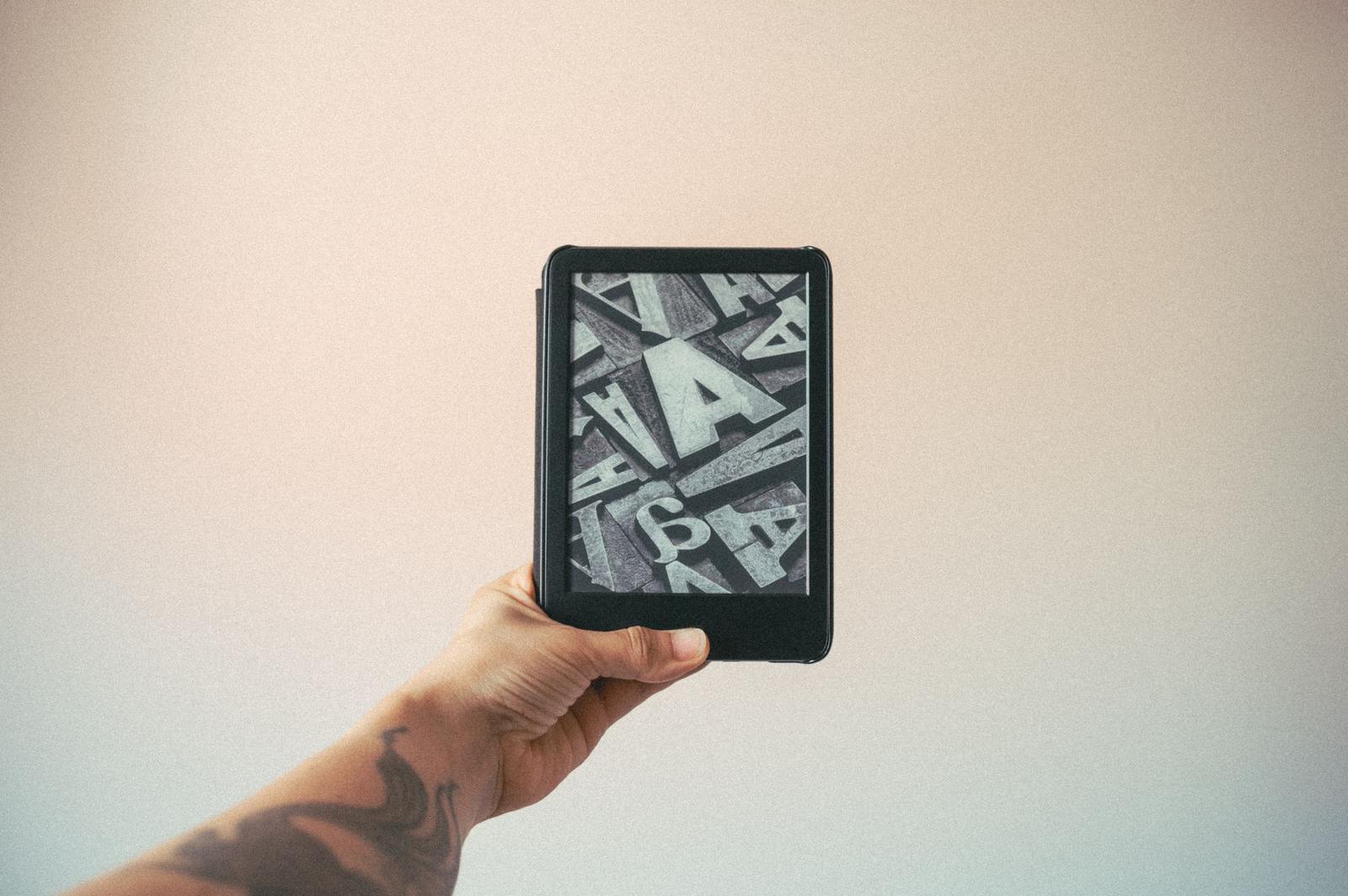
The ink is not used on its own. When laminated to a plastic film and adhered to electronics, it creates an Electronic Paper Display, also written ePaper or EPD. The film layer carries the ink, a thin-film transistor layer underneath addresses individual pixels, and a controller chip decides which pixels should change.
The idea has academic roots. Reference works record that E Ink Corporation was co-founded in 1997 by MIT undergraduates JD Albert and Barrett Comiskey together with a professor and other partners.
Inside a microcapsule
The best-known design is the two-particle system. E Ink describes it as made up of millions of tiny microcapsules, each about the diameter of a human hair. Every capsule is a small sealed container filled with a clear fluid and two kinds of pigment particles, one white and one black, carrying opposite electric charges.
Which colour the viewer sees depends on which particles sit at the top of the capsule, closest to the surface. E Ink explains that when a positive or negative electric field is applied, corresponding particles move to the top of the microcapsule where they become visible to the viewer. The surface then appears white or black at that spot.
A transparent electrode layer sits above the capsules and a grid of pixel electrodes sits below them. Applying one polarity to a pixel pulls the white particles upward and pushes the black ones down. Reversing the polarity does the opposite.
A related structure replaces capsules with cups. In its three-particle ink for shelf labels, E Ink says that instead of microcapsules, the system utilizes Microcups, which are filled with the liquid and sealed. The underlying principle is the same: charged particles are moved by a field.
- E Ink invented electrophoretic ink, often called electronic ink: electrophoretic ink
- Two-particle system uses microcapsules about the diameter of a human hair: human hair diameter
- That makes the surface appear white or black at that spot: white or black
- Three-particle Spectra 3000 uses Microcups instead of microcapsules for electronic shelf labels: Microcups
- Because E Ink screens are bi-stable, only changing regions require updating: bi-stable
Why the screen holds an image without power
The feature that sets e-paper apart from an LCD or OLED panel is that it is bistable. Once the particles have moved to their positions, they stay there. Power is needed to change the picture, not to keep it. A reference summary notes that the microencapsulated medium permits the fabrication of a bistable electronic display solely by means of printing.
E Ink applies the same property to updates. The company states that because E Ink screens are bi-stable, only the regions of the screen that are changing require updating, and that any pixels that are not changing do not require updating. For a reader, that means a static page of text uses essentially no display power while the user reads it.
This is the main reason e-readers are known for long battery life. A backlit phone or tablet screen is driven continuously, whereas an e-paper panel is idle between page turns. Actual battery life still depends on the front light, wireless use and the rest of the hardware, so the display is only one part of the picture.
Refresh speed and ghosting
Moving particles through a fluid takes longer than switching a liquid crystal. E Ink says an update can be quick in the best case: update times can be as short as 120 ms for the entire display. Different update modes exist to serve different needs, trading speed against image quality.
Fast modes are good for page turns, scrolling or handwriting. They can leave faint traces of the previous image, known as ghosting. Reference works illustrate this with an e-paper watch face that refreshes to remove ghosts.
Video is a different matter. E Ink says that using the faster update modes, its screens can support animation quality video rates, but constant updates reduce the power efficiency of our ink systems. The company also states that current production modules do not support video rate updates. Animations and web video on e-paper are therefore limited by design, not just by software.
The same slow, deliberate refresh matters for other devices with small low-power screens, a topic that comes up with smartwatch sensors and the displays that present their readings.
Colour e-paper
Black-and-white ink uses two kinds of particles. Colour requires either a filter layer or more kinds of particles. The approach used in many colour e-readers puts a colour filter array over a black-and-white ink layer. E Ink describes a Kaleido module as comprised of a TFT backplane, Ink layer, Color Filter layer and Protective Sheet, and says the displays offer 16 levels of grayscale and are capable of displaying 4096 colors.
The filter approach keeps the low power of monochrome e-paper and its sunlight readability: E Ink says Kaleido’s text and colour graphics are fully viewable in direct sunlight.
A second approach skips the filter. E Ink explains that with its Advanced Color ePaper platform, color is achieved by having all the colored particles in every pixel, removing the need for a color filter array. This multi-particle design is used in the company’s Gallery and Prism product lines. Particle systems with three or four colours are also used in electronic shelf labels and signage, a major use of the technology outside e-readers.
Front lights and what to check when choosing an e-reader
E-paper reflects ambient light, so in the dark it needs a front light. This is a thin light guide that shines onto the screen from the edges, rather than a backlight that shines through it. The panel itself is still reflective, which is why readers describe it as closer to paper than to a tablet.
When comparing e-readers, a few display questions are worth asking: whether the panel is monochrome or colour, how sharp the text is at the stated resolution, whether a front light with adjustable warmth is included, and how the device handles full refreshes. Software features such as file format support and store access matter as much as the panel, and are covered by the manufacturer’s own specification pages.
Connectivity affects daily use too. Syncing libraries and downloading books relies on the radio in the device, so the standards in wifi 6 vs wifi 7 are mostly irrelevant for page-turn speed but can matter for large downloads on devices that support newer Wi-Fi.
Where e-ink is used besides e-readers
E Ink’s own site lists applications that range from reading and writing devices to education, retail, logistics, healthcare and transportation. Electronic shelf labels are one example: the Spectra inks are described as engineered specifically for them, and a bistable panel only needs power when a price changes.
The same logic suits any product where a screen mostly shows a still image: the design trades full-motion video for a panel that stays readable in sunlight and draws power only when the content changes.
Frequently asked questions
Does an e-ink screen use power when it is not changing?
Show answer
Not to hold an image. Because the display is bistable, power is used when pixels change, not to keep them in place.
Why do e-readers flash black when turning pages?
Show answer
The flash is a full refresh. It drives the particles to a clean state so that traces of the previous page, called ghosting, are cleared.
Can e-ink show video?
Show answer
Not well. The manufacturer states that current production modules do not support video rate updates, and constant updates reduce the power efficiency of the ink.
Can e-ink display colour?
Show answer
Yes. Some panels add a colour filter layer over the ink, while others use coloured particles in each pixel. Colour panels generally look less vivid than backlit screens.