Action camera basics come down to four things: sensor size, stabilisation, waterproofing and mounts. Each one shapes how a small, rugged camera behaves on a helmet, a handlebar or a dive.
This page is an independent explainer and is not affiliated with any camera maker. For broader context on weighing specifications and longevity, the gadget buying guide covers the wider category of consumer gadgets.
What defines an action camera
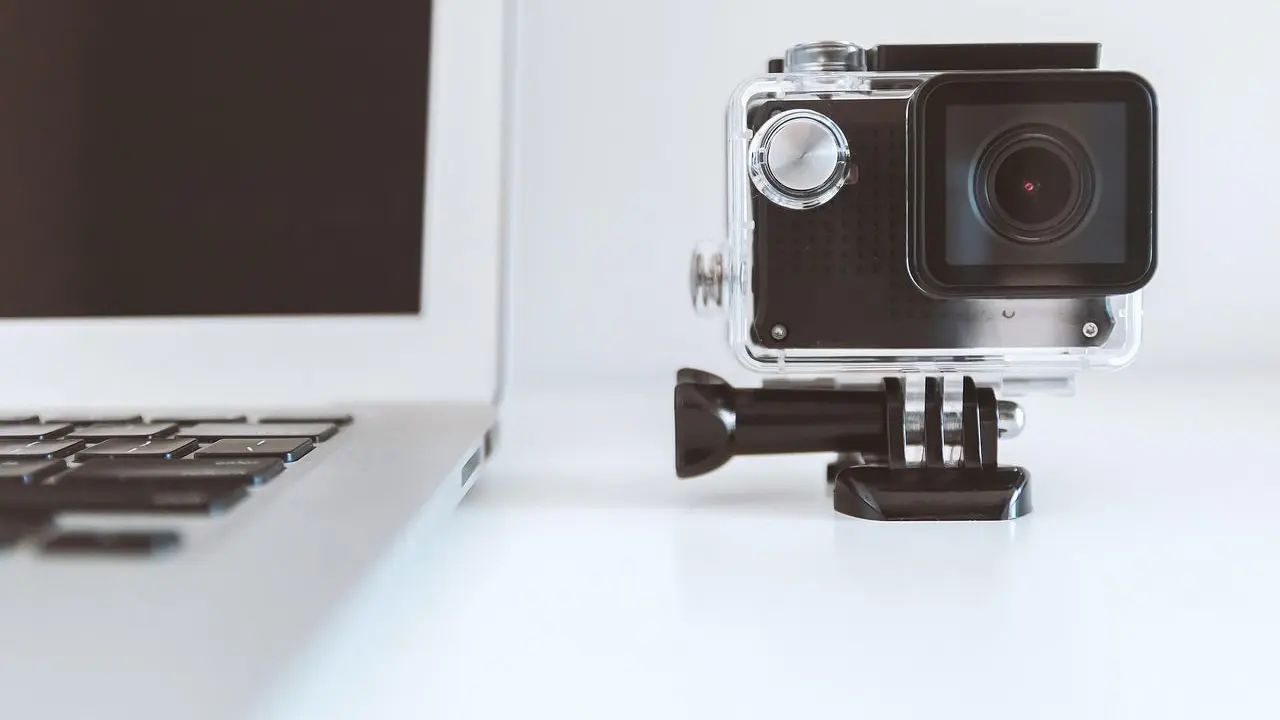
An action camera is a compact camera built to be attached to a person or a vehicle instead of held up to the eye. According to Wikipedia, an action camera is usually designed to require minimal interaction once recording has begun, which is why the design priorities are different from a phone or a compact camera. There is little emphasis on menus and a lot on starting a recording with one press and forgetting about it.
The same source notes that a typical action camera records onto a microSD card and has either a Micro-USB or a USB-C connector. That simple storage model matters later, because video files from a wide, high-resolution sensor are large and a card that is too slow or too small becomes the limit of a day out.
Because the camera is meant to be mounted, the body is usually small, light and boxy, with a lens that is wide enough to capture the surroundings of whoever or whatever carries it. Manufacturers publish these details on spec pages, and those pages are the best primary source for what a given model claims. The sections below explain how to read the main entries.
Sensor size and what it changes
The sensor is the chip that turns light into an image. In general, a larger sensor can collect more light for the same exposure, which tends to help in dim scenes, but the sensor is only one part of the chain with the lens, the processor and the stabilisation. Manufacturers describe sensor size in fractions of an inch. DJI lists a 1/1.3-inch CMOS sensor on both the Osmo Action 5 Pro and the Osmo Action 4.
Those fractions are labels rather than measurements. Wikipedia explains that the current digital image sensor size descriptors come from the equivalent size of old video camera tubes, not the actual size of the sensor. In practice, that means the figures are useful for comparing one camera with another and less useful for working out the physical dimensions.
Lens details sit next to the sensor on a spec sheet. DJI gives the Osmo Action 5 Pro an aperture of f/2.8 and a field of view of 155°. A wide field of view is what lets the camera capture the surroundings of a rider or a diver, and it explains the stretched look at the edges of the frame that action footage often has. A lower f-number means a wider aperture that admits more light, so aperture and sensor size work together when the light drops.
GoPro takes a different approach to the shape of the frame. Its HERO13 Black page advertises a tall image sensor that lets the user shoot wide, vertical or full-frame and decide on the crop later. For social video that is shot vertically and for traditional playback on a wide screen, a sensor with more height gives more room for that choice.
How stabilisation works
Stabilisation is the feature that separates action footage from shaky footage. Most action cameras do it electronically: the processor shifts and crops the image using motion data so that the picture appears steady even when the body of the camera is moving. GoPro describes its HyperSmooth system as in-camera video stabilization, and DJI calls its approach electronic image stabilisation, abbreviated EIS, with modes named RockSteady and HorizonSteady.
Each mode comes with limits that are easy to miss. DJI states on its Osmo Action 5 Pro specification page that EIS is not supported in timelapse and slow motion modes, and that HorizonSteady, which keeps the horizon level, is only available at a resolution of 1080p (16:9) or 2.7K (16:9) with a frame rate of 60fps or below. The point for a reader comparing models is that a stabilisation headline can come with conditions attached, so the footnotes on the spec page matter as much as the feature name.
That is another reason to look at the lens and sensor details together with the stabilisation name.
- Look at which resolutions and frame rates allow the strongest stabilisation mode.
- Check which recording modes disable it altogether.
- Note whether horizon levelling is offered, and under what conditions.
Waterproof ratings and housings
Many action cameras are waterproof without a case, within a stated depth. DJI lists the Osmo Action 5 Pro at 20 m without the waterproof case and 60 m with it, and the Osmo Action 4 at 18 m without it and 60 m with it. The Osmo Action 5 Pro and its waterproof case also carry an IP68 rating, according to DJI. GoPro lists the HERO13 Black as waterproof to 33 ft (10 m) out of the box, with a protective housing that extends that to 196 ft (60 m).
The depth is only part of the story. DJI states that before use the battery compartment cover and the USB-C port cover must be closed and the glass lens cover tightened. It also says not to use the camera in hot springs or extreme underwater environments, or to let it come into contact with corrosive or unknown liquids. A rating describes a sealed camera under stated conditions, so a reader should follow the manufacturer documentation for the model rather than assume the depth figure covers every situation.
A separate housing or case is a practical answer to long dives or high water pressure, since it adds a second layer of sealing and a second set of controls. Because the figures differ between models and between generations, they are best taken from the spec page of the exact camera rather than from a general rule.
Mounts, storage and battery
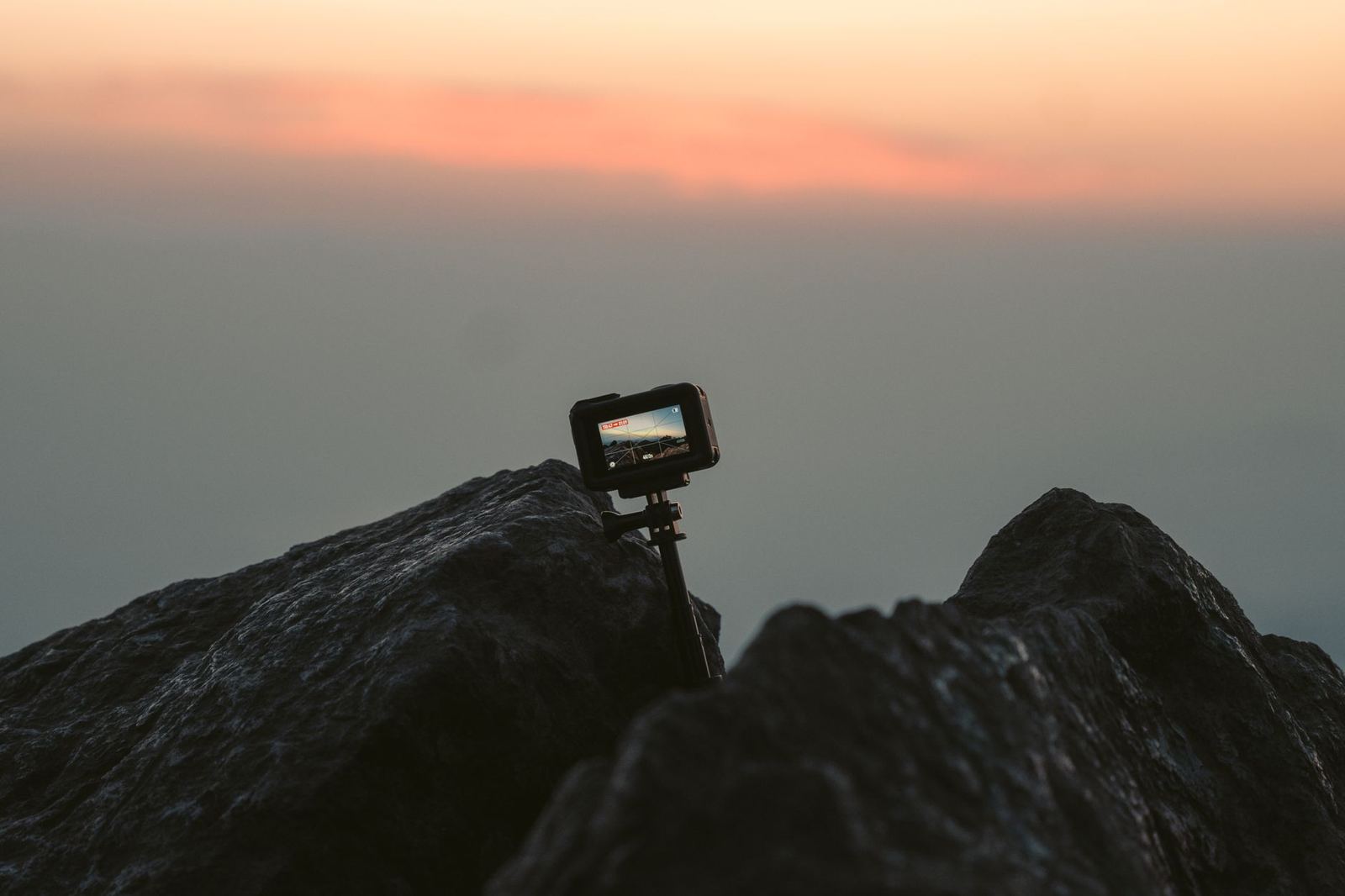
Mounting is the reason the category exists. Wikipedia lists common places to mount an action camera as a hat or helmet, the chest, or the handlebars of a bike or similar vehicle, and notes that tripods and monopods are also used for handheld shooting. A mount system that is shared between cameras and accessories makes it easier to move a camera between uses, though compatibility is always something to confirm with the maker of the mount.
Storage is the next practical question. DJI lists support for microSD cards up to 1 TB on the Osmo Action 5 Pro, and the camera also has built-in storage: 64 GB, with 47 GB available for use. High-bitrate video fills a card quickly, so people who record long sessions also need a plan for offloading footage. Readers building a backup routine can compare drives in the portable ssd vs hdd guide, which covers speed, durability and cost.
The battery is a smaller cell than a phone battery. DJI lists a 1950 mAh, 7.5 Wh battery for the Osmo Action 5 Pro and a 240 minute operating time, measured at 25° C while recording 1080p at 24fps with RockSteady on, Wi-Fi off and the screens off. DJI also gives an operating temperature of -20° to 45° C. The test conditions are stated because a different resolution, frame rate or temperature changes the runtime, so a quoted number is a reference point rather than a promise.
Lithium-ion batteries wear out and eventually need to be disposed of. The how to recycle electronics guide explains where to take old cameras and cells instead of putting them in household waste. Readers should follow the manufacturer documentation and local rules for battery handling.
Reading an action camera spec sheet
A spec sheet can be read in a consistent order. Start with the sensor size and the lens aperture, then the stabilisation mode and the conditions attached to it. Next, read the waterproof rating together with the instructions that go with it, and then the storage options and the stated runtime conditions. The footnotes are where the manufacturers record the conditions under which a figure holds.
It also helps to separate the claims that can be checked on paper from the ones that depend on use. A weight such as the 146 g listed for the Osmo Action 5 Pro, or a sensor size, is a fixed number. Stabilisation quality and low-light results depend on the scene, so they are best judged from published sample footage from independent reviewers. This site does not review or test products, and it does not compare models for purchase.
Frequently asked questions
Do all action cameras use the same sensor size?
Show answer
No. DJI lists a 1/1.3-inch sensor on the Osmo Action 5 Pro and the Osmo Action 4, but sensor sizes differ between makers and models, so the spec page of the exact camera is the reference.
Is electronic stabilisation available in every recording mode?
Show answer
No. DJI states that EIS is not supported in timelapse and slow motion modes, and that HorizonSteady has resolution and frame rate limits.
How deep can an action camera go without a case?
Show answer
It depends on the model. DJI lists 20 m for the Osmo Action 5 Pro and 18 m for the Osmo Action 4 without the waterproof case, and GoPro lists 33 ft (10 m) for the HERO13 Black.
What do action cameras record onto?
Show answer
A typical action camera records onto a microSD card and uses a Micro-USB or USB-C connector, according to Wikipedia. Some models, such as the Osmo Action 5 Pro, also include built-in storage.