Phone camera sensor size is the physical area of the chip that records light, and it is usually quoted as a fraction of an inch. A larger sensor can gather more light per photo, though lens, software and pixel layout shape the result too.
This independent explainer is not affiliated with any phone maker. It covers one spec among many, and the full list of what to weigh is in the guide on how to choose a smartphone.
Sensor size in plain terms
Every digital camera has an image sensor, a grid of light-sensitive cells called pixels. When the shutter opens, each pixel collects light and converts it into an electrical signal, and the phone builds a picture from the grid. A bigger sensor has more surface area to collect light, which is why makers advertise it when they launch a flagship model.
Samsung makes the point directly in its launch material for an image sensor. It says the ISOCELL Bright HMX, the first mobile image sensor to adopt a large 1/1.33-inch size, can absorb more light in low-lit settings than smaller sensors. That is a manufacturer statement about one product, but it matches the general reason sensor size is on spec sheets: dim scenes are where a small sensor runs out of light first.
Size alone does not decide the picture. The lens decides how much light reaches the sensor, the processor combines frames and reduces noise, and the user decides what to shoot. The sections below separate the parts that sensor size does change from the parts it does not.
Reading the inch labels
Sensor sizes appear as fractions of an inch, and the notation is confusing at first. The Wikipedia article on image sensor formats says that sizes are often expressed as a fraction of an inch, with a one in the numerator, and a decimal number in the denominator. A smaller denominator therefore means a larger sensor, so a label with a small denominator marks a bigger sensor than one with a large denominator.
The label is not a ruler measurement, however. The same article explains that the descriptors are the video camera tube equivalency size, not the actual size of the sensor, and gives the example that a 1″ sensor has a diagonal measurement of 16 mm. In other words the inch label is a naming convention inherited from old video tubes. It is good for ranking sensors against one another and poor for working out dimensions.
The same label also appears outside phones. DJI lists a 1/1.3-inch CMOS sensor on the Osmo Action 5 Pro, and Samsung describes its ISOCELL HP2 as being in a 1/1.3″ optical format, a size that is widely used in 108MP main smartphone cameras. The reuse of the same format across different products shows that the label describes a class of sensor, not one product.
- Samsung HMX product status: EOL
- Sensor size descriptors are not actual size: 1″ sensor = 16 mm diagonal
- Sizes are written as fractions of an inch: fraction of an inch
Pixels, pixel size and binning
Sensor size is the total area. Pixel size is the area of each cell, and the two are linked by resolution: fit more pixels into the same sensor and each one gets smaller. Samsung’s HP2 packs 200-million 0.6-micrometer pixels into its 1/1.3″ format, according to the company’s announcement. The earlier HMX uses 0.8 μm pixels at 108MP, according to its Samsung product page, which lists the product status as end of life.
Small pixels collect little light each, so phones merge neighbouring pixels in dim scenes. Samsung says the HP2, in low light, transforms into a 1.2μm 50MP or 2.4μm 12.5MP sensor by binding four to 16 neighboring pixels. Xiaomi describes a similar idea on its Leica main camera, listing a 50MP sensor with a 3.2μm pixel and a “4-in-1 Super Pixel” on the Xiaomi 14 Ultra specification page. The final image from such a camera therefore has fewer pixels than the sensor does, and each of them is larger.
This is one reason a headline megapixel count says little about quality on its own. The question of whether more megapixels help is covered separately, and for sensor size the useful reading is the optical format together with the pixel size after merging.
Different sensors for different cameras
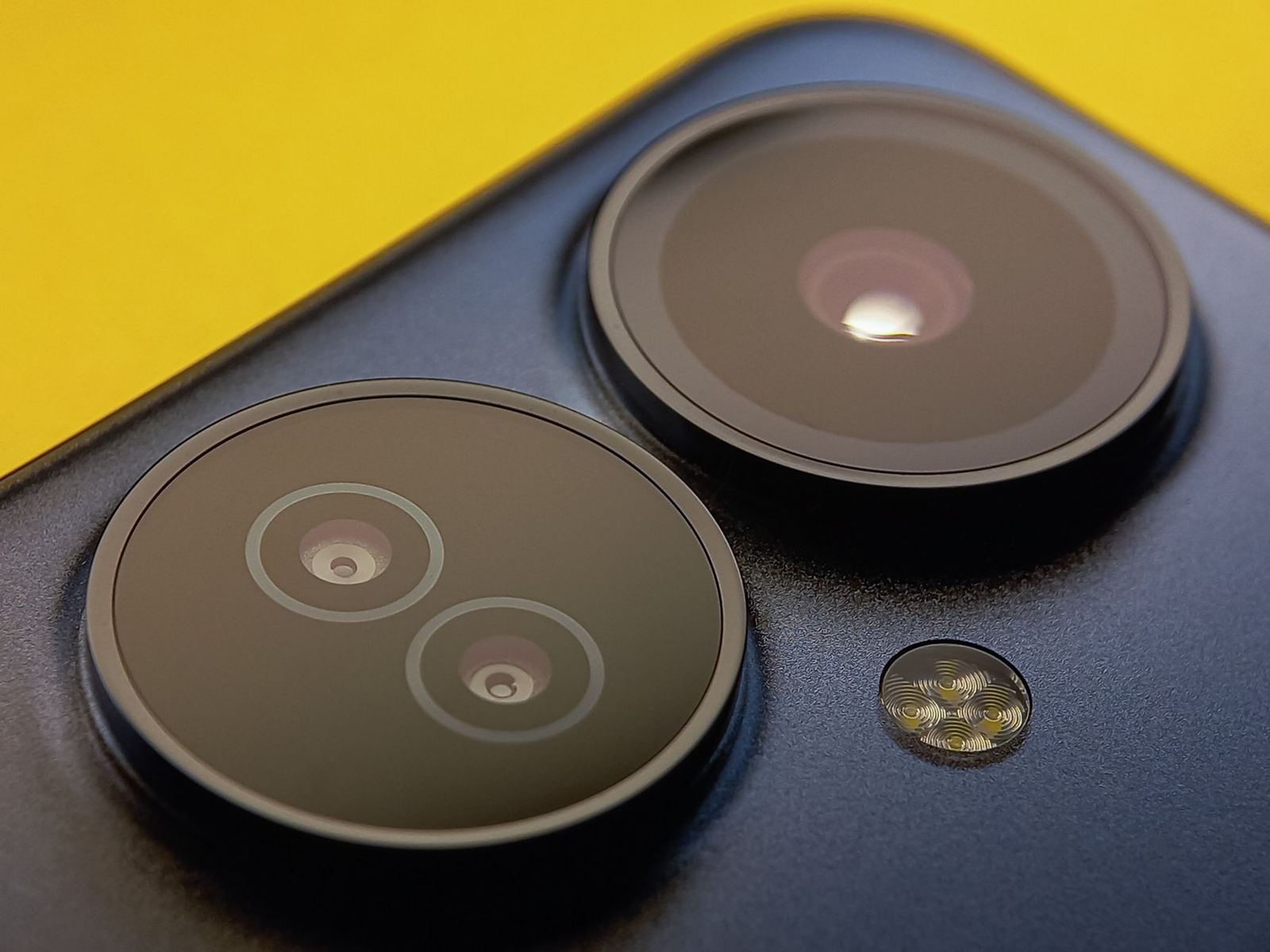
A modern phone has several cameras, and they do not share a sensor size. Xiaomi’s FAQ for its 17 Ultra says the wide-angle camera has a 1/2.75″ sensor, the main camera uses a 1″ sensor, and the telephoto camera is equipped with a 1/1.4″ sensor. The main camera gets the large sensor because it handles most shots, and the other lenses use sizes that fit the space inside the body.
The selfie camera is usually the smallest. On the Xiaomi 14 Ultra, the 32MP in-display selfie camera has an f/2.0 aperture and a 1/3.14” sensor. The same page lists the main camera as having a 1” sensor, so one phone spans a wide range of sizes between its front and rear cameras.
That matters when reading a review or a launch announcement: a claim about a phone’s sensor normally describes only the main camera. Zoom, ultrawide and front cameras on the same model can be several steps smaller, and their performance in low light follows that. Readers comparing phones can look up the sensor size for each camera instead of relying on a single figure.
What sensor size does not decide
It is tempting to treat the biggest number as the winner, but a spec sheet is a list of design choices and each choice trades something away.
A big sensor needs room, and room is limited in a thin phone. Makers pair large sensors with lenses that are designed around them, and Xiaomi’s variable aperture on the 14 Ultra main camera, listed as f/1.63-f/4.0, is one example of a lens system built for that sensor. Many other phones use a smaller sensor with software that combines several frames to recover detail.
Software processing, lens quality and stabilisation all affect the result, and manufacturers differ in how they tune colour and sharpening. For that reason, sensor size works best as one signal among several, not as a ranking of phones. This site does not test or review phones, and it does not rank them.
When upgrading to a phone with a different camera system, photos and videos are the content people most want to keep, so the transfer data to new phone guide covers moving them. The camera is also not the only radio-related or regulatory spec on the sheet, and the phone sar value guide explains the radio-frequency exposure rating listed in the same documentation.
Frequently asked questions
Is a 1/1.3-inch sensor bigger than a 1/2.75-inch sensor?
Show answer
Yes. Sizes are written as a fraction of an inch, so the smaller denominator marks the larger sensor, according to the Wikipedia article on image sensor formats.
Does a 1-inch sensor measure one inch across?
Show answer
No. The label is the equivalent video camera tube size, and Wikipedia gives a diagonal of 16 mm for a 1″ sensor.
Why do phones merge pixels on a high-resolution sensor?
Show answer
Small pixels collect little light each, so merging neighbouring pixels creates a larger effective pixel in dim scenes. Samsung describes this for the ISOCELL HP2, which binds four to 16 neighboring pixels.
Do all cameras on one phone use the same sensor size?
Show answer
No. Xiaomi lists three different sizes for the wide-angle, main and telephoto cameras of one phone, and a different one again for the selfie camera of another.